

Beneath the waves of the Southern Ocean, a magical form of hide-and-seek is always in play. While many creatures rely on speed or shells for defense, some have perfected the art of disappearing in plain sight. The ultimate illusionists of this underwater realm are the leafy and weedy sea dragon. These mesmerizing creatures, close relatives of seahorses, have evolved not with scales of glittering armor, but with breathtaking, living costumes that make them virtually indistinguishable from the swaying seaweed and kelp forests they call home. This article delves into the world of these enigmatic fish, exploring the secrets of their spectacular camouflage, their unique lives, and the delicate balance they maintain in their ecosystem.
What Are the Leafy and Weedy Sea Dragon?
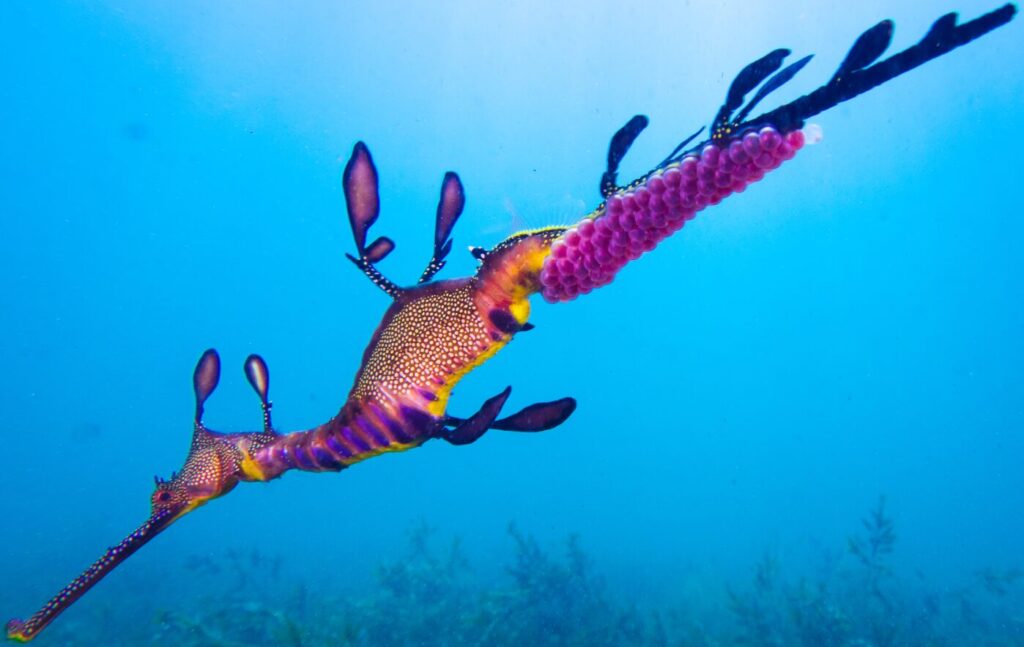
The leafy and weedy sea dragon are two distinct yet closely related species of marine fish belonging to the family Syngnathidae, which also includes seahorses and pipefish. They are endemic to the cool, temperate coastal waters of southern Australia. The Leafy Sea Dragon (Phycodurus eques) is renowned for its spectacular, leaf-like skin appendages that cover its entire body and head, giving it the appearance of a floating piece of drifting seaweed. The Weedy Sea Dragon (Phyllopteryx taeniolatus), while still ornate, features fewer, more rugged, and stem-like projections, resembling a piece of kelp or common marine weed. Together, they represent one of nature’s most extraordinary examples of evolutionary adaptation for survival.
The Science of Their Marine Camouflage
The survival of the leafy and weedy sea dragon depends entirely on their ability to remain unseen. Their camouflage is a multi-faceted strategy known as crypsis, where an organism avoids detection by blending into its environment. Their elaborate, leaf-like and weedy appendages are not for swimming—they are purely for disguise. These skin filaments lack any fin function and serve to break up the animal’s outline perfectly against a backdrop of algae and seagrass.
Furthermore, they possess specialized chromatophores—pigment cells in their skin—that allow them to slowly change color to better match their surroundings, shifting between shades of yellow, brown, green, and even vibrant red depending on the habitat, depth, and diet. Their movement is the final piece of the puzzle. They propel themselves with tiny, nearly transparent fins, creating a gentle, rocking motion that mimics the sway of surrounding vegetation pushed by ocean currents. This combination of form, color, and behavior makes the leafy and weedy sea dragon virtually invisible to both predators and the tiny mysid shrimp they feed upon.
Habitat and Lifestyle of the Leafy and Weedy Sea Dragon
These master camouflagers are found in specific, vegetation-rich marine environments. They primarily inhabit kelp forests, seagrass meadows, rocky reefs, and areas with abundant seaweed, typically at depths ranging from 3 to 50 meters. This habitat is not just their home; it is their entire disguise. The leafy and weedy sea dragon are ambush predators in the truest sense. They remain motionless or drift gently, then use their long, pipe-like snouts to create a powerful suction, instantly inhaling small crustaceans like mysid shrimp and sea lice.
Their life cycle is equally fascinating. In a remarkable role reversal, the male is responsible for childbearing. The female deposits up to 250 bright pink eggs onto a specialized brood patch—a spongy area of skin—on the underside of the male’s tail. He then carries and incubates these eggs for 4-6 weeks before giving birth to fully independent, miniature sea dragons.
Key Differences Between the Leafy and Weedy Sea Dragon
While often grouped together, the leafy and weedy sea dragon have distinct characteristics. The primary differences are in their physical ornamentation and build:
| Feature | Leafy Sea Dragon (Phycodurus eques) | Weedy Sea Dragon (Phyllopteryx taeniolatus) |
|---|---|---|
| Appendages | Profuse, elaborate, leaf-like lobes covering the body and head. | Fewer, simpler, stem-like or weedy projections. |
| Body Shape | More intricate and convoluted outline, with appendages obscuring the body. | More streamlined, pipe-like body with visible neck; appendages mainly along the spine. |
| Size | Generally slightly larger, up to 35 cm (14 in) in length. | Slightly smaller on average, up to 46 cm (18 in) but typically slimmer. |
| Color & Pattern | Often yellow and brown with olive-toned “leaves.” May have pale blue spots. | Usually more reddish with yellow and purple markings; distinct dark bands and bright blue dots along the body. |
| Distribution | More restricted range, primarily off the coast of South and Western Australia. | Wider range, found along the entire southern coastline of Australia, including Tasmania. |
Conservation Status and Threats
Despite their formidable camouflage, the leafy and weedy sea dragon face significant human-induced threats. Their limited habitat makes them vulnerable to pollution, coastal development, and agricultural runoff. They are also at risk from illegal collection for the private aquarium trade, boat strikes, and entanglement in marine debris. Furthermore, climate change poses a long-term threat by warming oceans and altering the delicate kelp forest ecosystems they depend on.
Both species are fully protected in Australian waters and are listed on the IUCN Red List (the Leafy as Near Threatened, the Weedy as Least Concern but declining). They are also included in CITES Appendix II, regulating international trade. Conservation efforts are focused on protecting critical habitats through Marine Protected Areas (MPAs), public education campaigns to promote responsible diving and fishing practices, and ongoing scientific research. Protecting the leafy and weedy sea dragon is not just about saving two charismatic species; it is about preserving the health and biodiversity of the entire southern Australian marine ecosystem they symbolize.
Conclusion
The leafy and weedy sea dragon stand as breathtaking testaments to the power of evolution and the endless creativity of nature. Their existence revolves around a single, perfected principle: becoming one with their environment. As masters of marine camouflage, they are more than just beautiful curiosities; they are vital indicators of ocean health and ambassadors for the fragile, underwater worlds they inhabit. By understanding and protecting these iconic creatures, we help ensure the survival of the intricate and vibrant kelp forest communities for generations to come.