

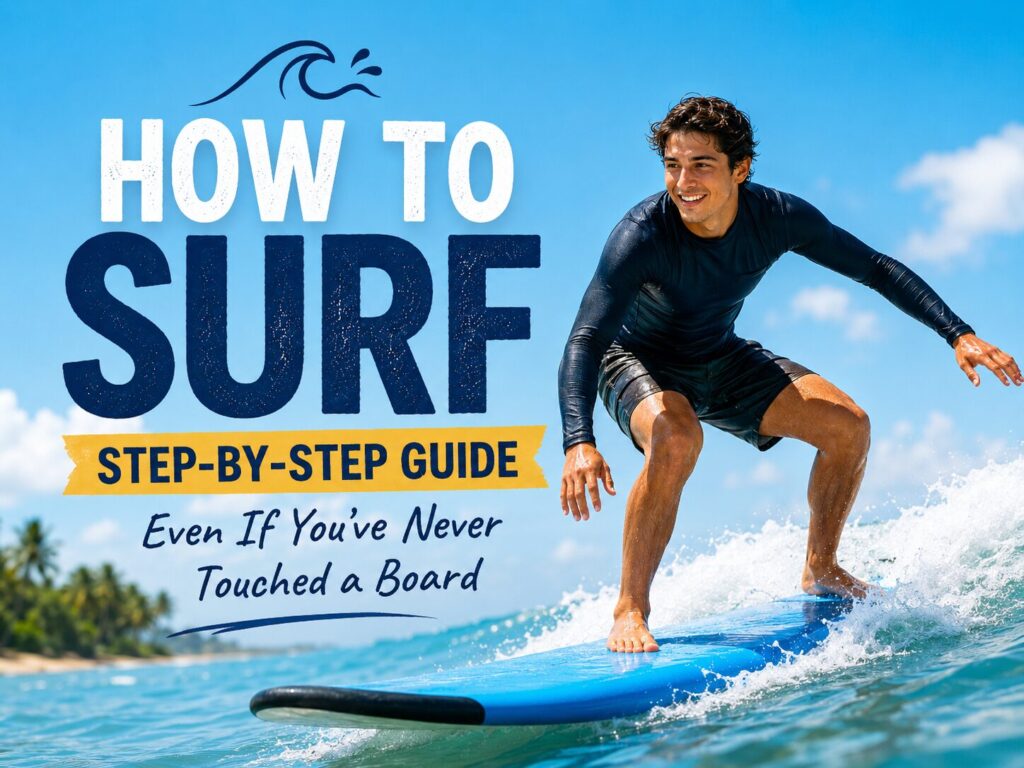
Surfing can look almost impossible when you’re watching from the beach. Someone paddles into a wave, pops up in one smooth move, and glides across the water like they were born doing it. Meanwhile, you might be standing there wondering how anyone even balances on a moving board in the first place.
The good news is that surfing does not have to start with big waves, perfect balance, or years of ocean experience. Most people who learn to surf begin exactly where you are now: curious, a little nervous, and unsure what to do first. The trick is to break the process down into small, simple steps.
This guide is built for surfing for beginners. You’ll learn how to choose the right beginner surfboard, where to practice, how to paddle, how to pop up, how to catch whitewater waves, and how to stay safe while building confidence. Your first time surfing does not need to be perfect. It just needs to be safe, fun, and simple enough that you want to try again.
Start With the Right Board, Not the Coolest One
One of the biggest beginner surfing mistakes is choosing a board that looks exciting instead of one that actually helps you learn. Shortboards may look sharp and fast, but they are not friendly for most first-time surfers. They are harder to paddle, harder to balance on, and much less forgiving when you make mistakes.
For your first surf session, a soft-top longboard or foam surfboard is usually the best choice. These boards are wider, thicker, and more stable, which means they float better and give you more time to find your balance. A beginner surfboard should make surfing feel possible, not frustrating.
A good beginner board usually has:
- Plenty of length for stability
- Enough width so you do not wobble too much
- High volume so it floats easily
- A soft top for extra safety
- A rounded nose that feels more forgiving in small waves
If you are taking a surf lesson, the surf school will usually provide the right board. If you are renting, tell the rental shop it is your first time surfing. Do not be shy about that. Getting the right board can make the difference between catching waves and spending the whole session fighting the ocean.
A larger board does not make you less of a surfer. It makes you a smarter beginner. Once you learn how to paddle, balance, pop up, and ride small waves, you can slowly move toward smaller boards if that is your goal.
Pick a Beginner-Friendly Surf Spot
Before you even touch the water, you need to choose the right place to learn. Not every beach is good for beginner surfers. Some surf spots have powerful waves, sharp reefs, rocks, strong rip currents, or crowded lineups full of experienced surfers. Those places are not where you want to start.
A safe beginner surf spot usually has small, gentle waves and a sandy bottom. You want waves that are soft enough to practice on but still strong enough to push your board toward shore. For learning, knee-high to waist-high waves are usually enough.
Look for a surf spot with:
- Small, mellow waves
- Sandy bottom instead of reef or rocks
- Lifeguards nearby when possible
- A clear beginner area
- Enough space between surfers
- Surf schools or instructors in the area
If the beach looks too intense, it probably is. Beginners often feel pressure to “just go for it,” but surfing is much more enjoyable when the conditions match your ability. There is no shame in waiting for a smaller day or asking a local surf shop where beginners should go.
Checking a surf report can also help, but surf reports can feel confusing at first. If terms like swell period, tide, wind direction, and wave height make your head spin, keep it simple. Ask someone who knows the area. A surf instructor, lifeguard, or rental shop worker can usually tell you whether the waves are suitable for beginner surfing that day.
Learn the Ocean Before You Learn the Tricks
Surfing is not only about standing on a board. It is also about understanding the ocean. The water is always moving, and waves do not arrive one by one in a neat pattern. They come in sets, change size, break in different places, and sometimes create currents that pull you sideways or away from shore.
That does not mean you should be scared. It means you should pay attention.
Before paddling out, spend a few minutes watching the water. Notice where the waves are breaking. Watch where other beginners are practicing. Look for channels, currents, and areas where people seem to drift. If there are lifeguards, stay near the guarded zone.
A few beginner surf safety tips can make your first session much smoother:
- Never surf alone as a beginner
- Always wear your leash
- Start in whitewater waves before going deeper
- Keep your board under control
- Stay away from swimmers
- Do not paddle into crowded areas
- Avoid surfing when waves look too powerful
- Learn what rip currents look like
- Listen to lifeguards and local warnings
Rip currents are especially important to understand. A rip current is a strong flow of water moving away from shore. If you get caught in one, do not try to paddle or swim straight against it. Stay calm, move parallel to the beach, and get out of the current before heading back in.
Ocean safety is not the boring part of learning how to surf. It is what allows you to relax enough to actually enjoy the ride.
Get Comfortable Handling the Board
Before you start paddling into waves, spend a little time getting used to your surfboard. A board can feel awkward at first, especially if it is long. Carrying it, turning it around, lying on it, and keeping it steady in shallow water are all part of the learning process.
When walking with your board, keep the nose facing forward and hold it close enough that the wind does not catch it. Once you are in the water, always be aware of where the board is. Your surfboard is helpful, but it can also bump into you or others if you let go of it at the wrong time.
This is why the leash matters. A leash connects your ankle to the board so it does not float away after you fall. Still, a leash is not an excuse to throw your board around. Try to hold onto it whenever possible, especially when other people are nearby.
Beginners should also learn how to position themselves on the board while lying down. If you are too far back, the nose will rise and the board will drag. If you are too far forward, the nose may dip underwater. You want your body centered so the board glides smoothly.
A simple way to check: when you paddle, the nose of the board should sit just slightly above the water, not pointing up like a ramp and not diving under.
Find Your Surf Stance on Dry Land
Before you try standing up in the water, practice your surf stance on land. It may feel silly, but it helps. Surfing moves quickly once a wave catches you, so your body needs some idea of where to go before the board starts sliding under you.
There are two common surf stances:
- Regular stance: left foot forward, right foot back
- Goofy stance: right foot forward, left foot back
Neither one is better. Your best surf stance is simply the one that feels natural. If you have skateboarded, snowboarded, or wakeboarded before, you may already know your stance. If not, try both and see which one feels more balanced.
Once you know your stance, practice standing with your feet about shoulder-width apart. Bend your knees slightly. Keep your chest open and your eyes looking forward. Try not to stand stiff and tall. A low, relaxed stance gives you better control.
Many new surfers make the mistake of looking down at their feet. The problem is that your body follows your eyes. If you stare down, you often lose balance. Look where you want to go, even if that is just straight toward the beach.
Practice the Pop-Up Until It Feels Less Awkward
The pop-up is the move that takes you from lying on the board to standing. It is one of the most important skills in surfing for beginners, and it usually feels clumsy at first. That is completely normal.
You do not need a dramatic jump. You need a smooth, controlled movement that gets your feet under you quickly.
Here is a simple beginner pop-up:
- Lie on your stomach as if you are paddling.
- Place your hands flat on the board near your lower ribs.
- Push your chest up.
- Bring your front foot forward between your hands.
- Place your back foot behind you.
- Keep your knees bent.
- Look forward, not down.
Try this on sand before going into the water. Do it slowly at first. Then build speed. The goal is not to look athletic. The goal is to land in a stable position without overthinking every movement.
Some beginners prefer a step-up method instead of a quick pop-up, especially on large foam boards. That can work in the beginning, but try not to depend on your knees too much. Dragging your knees under your body can slow you down and make it harder to stand before the wave loses power.
A useful beginner surf tip is to practice five or ten pop-ups before each session. It warms up your body and reminds your muscles what to do when the wave comes.
Learn How to Paddle Without Wasting Energy
A lot of new surfers think standing up is the hardest part. Then they get in the water and realize paddling is where most of the work happens. You paddle to move into position, paddle to catch waves, and paddle back out after riding or falling.
Good paddling does not mean splashing as hard as possible. It means using long, steady strokes and keeping your body balanced on the board.
For better paddling:
- Keep your chest slightly lifted
- Stay centered on the board
- Reach forward with each arm
- Pull smoothly through the water
- Avoid short, frantic strokes
- Keep your legs relaxed behind you
- Look where you are going
When a wave approaches, you need to paddle early enough to build speed. Many beginners wait until the wave is already on top of them, then try to paddle in a panic. By then, it is usually too late.
Think of paddling as matching the wave’s energy. You want the board moving before the wave reaches you. When the wave starts to lift and push the board, that is your signal to pop up.
Start With Whitewater Waves
Whitewater waves are broken waves that roll toward the beach in a foamy line. They may not look as glamorous as clean, unbroken green waves, but they are perfect when you are learning how to surf.
Whitewater gives you a push without requiring perfect timing. You do not need to read the wave face or angle across the shoulder. You can point your board toward shore, paddle, feel the wave catch you, and practice popping up.
For your first time surfing, whitewater waves are your best friend.
Here is how to catch one:
- Walk your board into waist-deep or chest-deep water.
- Turn the board so the nose points toward the beach.
- Lie centered on the board.
- Look behind you for a broken wave coming in.
- Start paddling before the foam reaches you.
- When you feel the board speed up, place your hands and pop up.
- Stay low and keep your eyes forward.
You will probably fall. You may fall many times. That is not failure. Falling is part of surfing. Every surfer, even the ones who look effortless, has spent plenty of time tumbling around in the foam.
When you fall, cover your head with your arms, come up calmly, find your board, and reset. Try not to get annoyed after every wipeout. The ocean gives instant feedback, but it does not judge you.
Move Toward Small Green Waves When You’re Ready
After you feel comfortable catching whitewater waves, you can start thinking about green waves. A green wave is an unbroken wave. It has a smooth face and gives you the chance to ride along the wave instead of just going straight toward shore.
Green waves require better timing. You need to be in the right spot, paddle with enough speed, and pop up at the right moment. If you go too early, the wave may pass under you. If you go too late, the wave may break on top of you.
Do not rush this stage. Many beginners want to skip straight to “real waves,” but whitewater practice builds the foundation you need.
When trying your first small green wave:
- Choose a soft, slow wave
- Sit or lie where the wave begins to build
- Paddle before the wave reaches you
- Keep your board pointed mostly toward shore at first
- Pop up when you feel the wave lift the tail of the board
- Stay low and relaxed
- Let the ride be messy
At first, you may only ride for a second or two. That still counts. Surfing is built on tiny improvements. One day you catch the foam. Then you stand for half a second. Then you ride straight. Then you angle slightly. Then suddenly, you realize you are actually surfing.
Keep Your Eyes Up and Your Body Relaxed
One of the simplest beginner surf tips is also one of the easiest to forget: look where you want to go. Many new surfers stare at the nose of the board or look down at their feet during the pop-up. That usually leads to falling.
Your eyes guide your body. If you look down, your shoulders drop, your balance shifts, and the board becomes harder to control. If you look forward, your body naturally opens up and feels more stable.
Try to keep your knees bent, arms loose, and weight centered. Do not lock your legs. Do not wave your arms wildly if you start wobbling. A relaxed body adjusts better than a stiff one.
Your stance should feel athletic but not tense. Imagine you are standing on a moving bus or balancing on soft sand. You would not stand straight and rigid. You would bend slightly and let your body absorb movement.
Surfing is the same. The board is moving, the water is moving, and you need to move with it rather than fight every wobble.
Understand Basic Surf Etiquette Before Joining Others
Surf etiquette matters because it keeps everyone safer and makes the surf spot more enjoyable. As a beginner, you do not need to know every unwritten rule right away, but you should understand the basics before paddling near other surfers.
The most important rule is not to drop in. Dropping in means taking off on a wave that another surfer is already riding. In general, the surfer closest to the peak of the wave has priority.
Basic surf etiquette includes:
- Do not take someone else’s wave
- Wait your turn
- Do not paddle through the middle of the lineup
- Hold onto your board
- Give other surfers space
- Apologize if you make a mistake
- Do not sit directly in front of someone waiting for a wave
If you are unsure where to sit, stay away from the crowded peak and practice closer to the beginner area. Watch how other surfers move. Notice where they paddle out, where they wait, and how they take turns.
Most experienced surfers can tell when someone is new. They are usually much more patient with beginners who are aware, respectful, and honest about their skill level.
Wear the Right Gear for the Conditions
What you wear for surfing depends on the water temperature, weather, and location. In warm water, you may only need a swimsuit and rash guard. In cooler water, a wetsuit can make a huge difference. Being cold drains your energy quickly and makes it harder to focus.
A rash guard helps protect your skin from board rash and sun exposure. A wetsuit keeps you warm and adds a little padding when you fall. The thickness of the wetsuit depends on the water temperature, so ask a local surf shop if you are not sure.
Basic beginner surf gear usually includes:
- A soft-top surfboard
- A leash
- A wetsuit or rash guard
- Surf wax if the board needs it
- Reef-safe sunscreen
- Towel
- Water bottle
- Warm clothes for after the session
You do not need to buy everything before you learn to surf. Renting gear or booking a beginner surf lesson is often the easiest way to start. It lets you try surfing without spending a lot of money on equipment you may want to change later.
Take a Lesson If You Can
You can learn a lot by reading and watching videos, but a surf lesson can save you hours of confusion. A good instructor will help you choose the right board, explain the surf spot, teach ocean safety, correct your pop-up, and push you into beginner-friendly waves.
That last part matters. Many beginners struggle because they cannot tell which waves to catch or when to start paddling. An instructor can stand nearby, watch the waves, and tell you exactly when to go. That kind of guidance makes your first time surfing much less stressful.
A surf lesson is especially helpful if:
- You are nervous in the ocean
- You do not know how to read waves
- You are unsure about surf etiquette
- You want faster feedback
- You are learning at a new beach
- You do not have your own gear
Even one lesson can give you a strong foundation. After that, your solo practice sessions will feel more focused because you will understand what you are trying to improve.
Avoid the Mistakes That Make Surfing Harder
Every beginner makes mistakes. That is part of the process. But some mistakes can make learning more frustrating than it needs to be.
A common mistake is using a board that is too small. Smaller boards may look more advanced, but they make catching waves much harder. Another mistake is trying to surf waves that are too big. Big waves do not help you learn faster. They usually just make you tired, nervous, and less confident.
New surfers also tend to paddle too late. If you wait until the wave is already breaking behind you, you will not have enough speed. Start paddling early and commit to the wave.
Other beginner mistakes include:
- Looking down during the pop-up
- Standing too tall
- Putting both feet too close together
- Leaning too far back
- Forgetting to bend the knees
- Ignoring currents and conditions
- Practicing in crowded areas
- Giving up after a few falls
The best way to improve is to focus on one thing at a time. Maybe today’s goal is simply to paddle better. Next time, it might be landing your feet in the right place. After that, it might be staying low for a longer ride.
Trying to fix everything at once usually makes surfing feel overwhelming. Small goals work better.
Build Confidence One Wave at a Time
Surfing has a funny way of testing your patience. One session might feel amazing, and the next one might feel like you forgot everything. That is normal. Progress in surfing is not always a straight line.
You might stand up on your first day, or you might need several sessions before it clicks. Neither one says much about your long-term potential. What matters is that you keep learning how the board, your body, and the ocean work together.
You are improving when:
- You feel calmer in the water
- You can position yourself better on the board
- Your paddling becomes smoother
- You notice waves earlier
- Your pop-up feels quicker
- You fall with less panic
- You ride a little farther than before
These small wins matter. Surfing is not only about the perfect ride. It is also about learning to read the water, laugh at your wipeouts, and come back for another try.
The more time you spend in the ocean, the less strange everything feels. The board becomes easier to handle. The waves become easier to understand. Your body starts reacting faster. What felt impossible at first slowly becomes familiar.
Make Your First Surf Session Simple
For your first surf session, do not overcomplicate things. Choose a safe beach, use a beginner surfboard, start in whitewater, and focus on the basics. You do not need to paddle far out. You do not need to catch green waves right away. You do not need to look smooth.
A simple first session might look like this:
- Watch the waves for a few minutes
- Warm up on the beach
- Practice your pop-up on land
- Enter the water with your board under control
- Catch whitewater waves
- Try standing up
- Rest when you get tired
- End while you still have energy
That last point is important. Surfing can wear you out quickly, especially when you are new. Once you get tired, your paddling gets weaker, your pop-up gets slower, and your awareness drops. There is nothing wrong with taking breaks or ending the session early.
A good first surf session is not measured by how many waves you ride. It is measured by whether you learned something, stayed safe, and left the beach wanting another chance.
Let Surfing Feel Awkward at First
Nobody feels graceful at the beginning. Your board may feel too big. Your pop-up may feel messy. You may fall in shallow water. You may miss waves you thought you had. You may get pushed around by foam and come up with saltwater in your nose.
That is all part of learning how to surf.
The surfers you admire have all been beginners. They have all missed waves, pearled the nose of the board, fallen during easy takeoffs, and made awkward mistakes. Surfing looks smooth only after a lot of trial and error.
So give yourself room to be new. Start small. Ask questions. Take breaks. Celebrate the tiny moments, like catching your first push from a wave or standing for one full second longer than last time.
The ocean rewards patience. The more you show up, the more it teaches you. And one day, maybe sooner than you expect, you will paddle into a small wave, feel the board lift, pop to your feet, and glide forward with a huge smile on your face.