

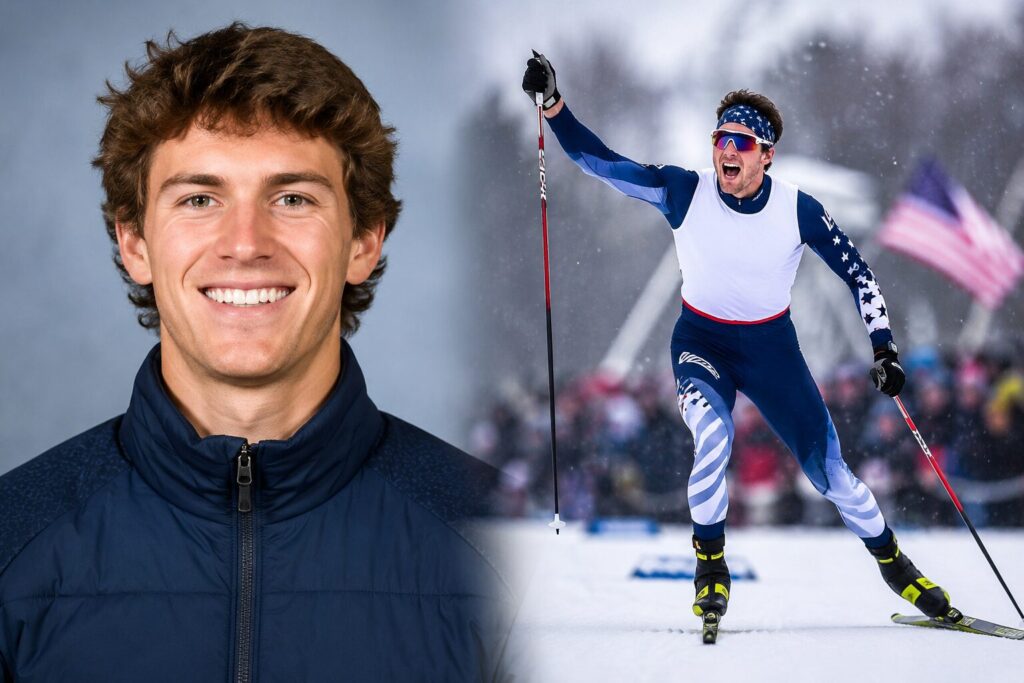
Cross-country skiing demands exceptional endurance, technical skill and the ability to perform in difficult winter conditions. Gus Schumacher has shown all three while becoming one of the most successful American men in modern Nordic skiing.
From his childhood on the trails of Anchorage to winning World Cup races and an Olympic silver medal, Schumacher’s rise has brought fresh attention to the U.S. men’s cross-country ski team. His story is not simply about collecting results. It is also about growing up in Alaska, competing against Europe’s strongest skiers and helping change expectations for American cross-country skiing.
Who Is Gus Schumacher?
Gus Schumacher is an American cross-country skier from Anchorage, Alaska. Born on July 25, 2000, he represents the United States in international events such as the FIS Cross-Country World Cup, the Nordic World Ski Championships and the Winter Olympics.
He has been part of the U.S. national team since 2019 and is connected with the Alaska Pacific University Nordic Center. Schumacher also studied engineering at the University of Alaska Anchorage.
His career highlights include:
- Two individual World Cup victories
- Three individual World Cup podiums
- An Olympic silver medal in the men’s team sprint
- Individual gold at the 2020 Junior World Championships
- A top-10 finish at the 2025 Nordic World Championships
These achievements have made Gus Schumacher one of the leading figures in the future of American Nordic skiing.
Growing Up in Alaska
Schumacher grew up skiing in Anchorage, where long winters and an active outdoor community gave him plenty of opportunities to develop. Nordic skiing is deeply rooted in Alaska, and local trails, ski clubs and experienced coaches helped create a strong environment for young athletes.
His progress was steady rather than sudden. He moved from local competitions into national junior events before testing himself against international racers.
In 2019, Schumacher helped the United States win gold in the relay at the Junior World Championships. A year later, he became the first American man to win an individual Junior World Championship title when he took gold in the 10-kilometer classic race.
That victory showed he could compete with young skiers from countries where cross-country skiing is one of the biggest winter sports.
Gus Schumacher’s World Cup Breakthrough
The move from junior skiing to the FIS Cross-Country World Cup is challenging. Athletes face stronger competition, frequent international travel and changing snow conditions throughout a long racing season.
Schumacher’s biggest World Cup breakthrough came in February 2024 at Theodore Wirth Park in Minneapolis. Racing in front of an American crowd, he won the men’s 10-kilometer freestyle event.
The result made him the youngest American man to win a World Cup race. He also became the first U.S. man since Bill Koch in 1983 to win a World Cup distance event.
The Minneapolis victory mattered because it proved Schumacher could defeat the world’s best Nordic skiers, not just compete alongside them. He later finished second in a 20-kilometer freestyle mass start in Falun, Sweden, and earned another World Cup victory during the 2025 Tour de Ski in Toblach, Italy.
Gus Schumacher at the Winter Olympics
Schumacher made his Olympic debut at the 2022 Beijing Winter Games. He returned four years later as a more experienced athlete with World Cup victories and major international results behind him.
At the 2026 Milano Cortina Winter Olympics, Schumacher partnered with fellow American skier Ben Ogden in the men’s team sprint. The pair won silver, earning the first Olympic medal for a U.S. men’s team in that event. Schumacher also competed in every men’s cross-country skiing event at the Games.
The team sprint requires two skiers to alternate fast laps around a short course. It combines speed, endurance, quick recovery and smart positioning. Schumacher’s distance strength and Ogden’s sprinting ability created an effective combination for Team USA.
What Makes Gus Schumacher a Strong Skier?
An elite Olympic cross-country skier needs more than cardiovascular fitness. Racing also requires upper-body strength, efficient technique and the ability to make quick tactical decisions.
Schumacher is especially strong in freestyle, commonly known as skate skiing. However, his junior world title in the classic technique shows that he can perform across different race formats.
His main strengths include:
- Strong endurance in distance races
- Efficient climbing technique
- Smart positioning in mass-start events
- The ability to maintain speed late in a race
- A calm approach under pressure
Cross-country races can be decided by seconds. Athletes must know when to conserve energy, follow an attack or push ahead of the group. Schumacher’s best performances show that he can remain patient before making a decisive move.
How Gus Schumacher Trains
Professional cross-country skiers train throughout the year, even when snow is unavailable. During the off-season, their preparation often includes roller skiing, running, cycling, hiking and strength training.
Roller skiing allows athletes to practise classic and freestyle movements on paved roads. Long endurance sessions build aerobic fitness, while interval workouts prepare the body for the intense climbs and fast finishes found in World Cup races.
Winter training becomes more specific. Skiers focus on technique, pacing and equipment testing while managing travel and recovery between competitions.
Ski preparation is also important. Temperature, snow moisture, wax selection and ski stiffness can all affect performance. Schumacher’s equipment partners include Rossignol, Swix, Toko, Swenor and Polar.
Life Away From Racing
Although skiing takes up much of his schedule, Schumacher has several interests outside professional competition. His U.S. Ski & Snowboard profile mentions backcountry skiing, motocross, paddleboarding, video games and commercial salmon fishing. He has also volunteered with Special Olympics.
His connection to nature has also shaped his environmental advocacy. Schumacher works with Protect Our Winters, an organization focused on the effects of climate change on outdoor communities and winter sports.
This issue is especially personal for Nordic skiers. Warmer winters, unreliable snowfall and changing race conditions can affect training locations, local clubs and international competitions.
With World Cup victories, a historic junior title and an Olympic silver medal already on his record, Gus Schumacher has become an important part of the U.S. men’s cross-country ski team. His continued success could inspire more young American skiers while strengthening the country’s place in international Nordic skiing.